
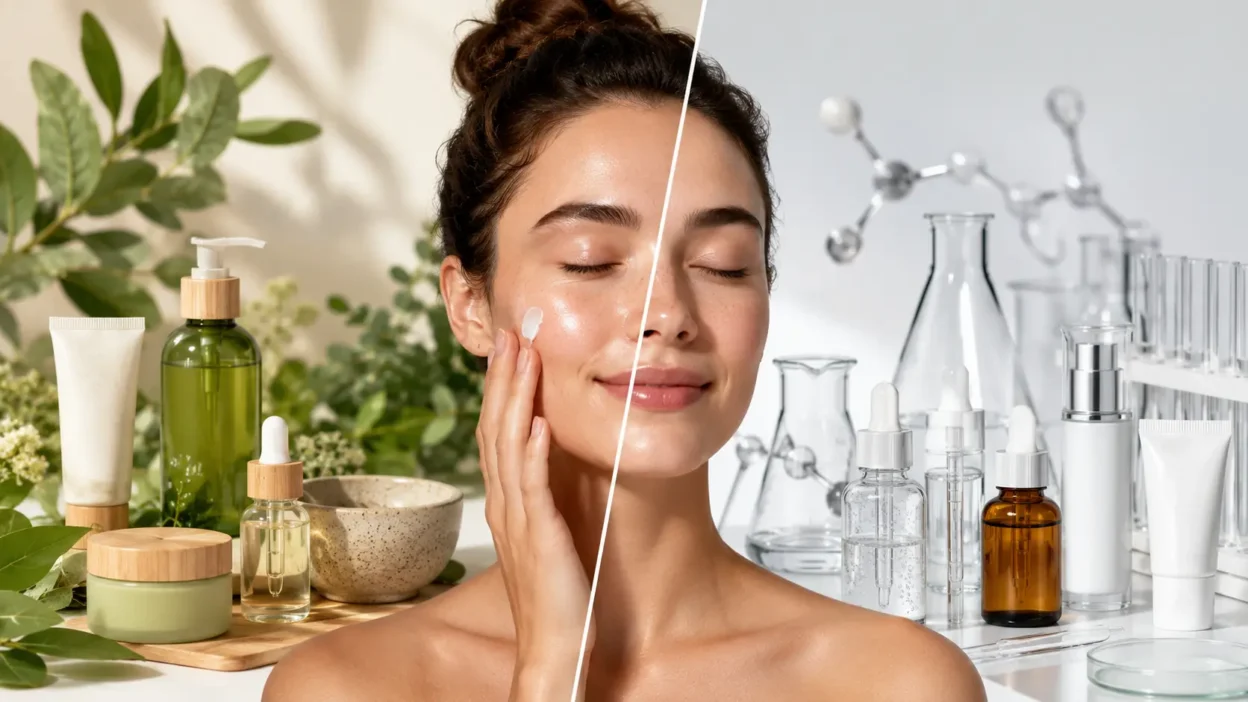
When building a modern skincare regimen, many people find themselves torn between clean beauty vs active ingredients. While clean beauty focuses on eliminating potential irritants and harmful chemicals, targeted active ingredients like Vitamin C and Retinol provide proven, clinical results for skin texture and tone. The most effective approach doesn’t require choosing one over the other—it simply combines safe, non-irritating formulas with powerful active ingredients for optimal skin health.
Walk down any skincare aisle in the US, and you’ll see a similar set of marketing terms – clean, non-toxic, natural, dermatologist-approved – applied to countless products. That may make you feel good, but you may be wondering what exactly qualifies as safe and effective skincare. Here is the good news – you can actually achieve both by combining the right active ingredients with a clean beauty approach.
Below is a breakdown of how to get it all – the benefits of active skincare ingredients and the peace of mind that comes with clean beauty.
What Does “Clean Beauty” Really Mean?
“Clean beauty” is a recently-emerging trend promoting the use of cosmetics free of parabens, sulfates, phthalates, and artificial fragrance. While such an approach is generally beneficial due to the reduced amount of potentially irritating chemicals on the skin, it is also important to understand that the term “clean beauty” is completely unregulated. There is no official definition describing what substances can or cannot be present in cosmetics labeled as “clean” and regulated by FDA or similar institutions. Therefore, the term is more of a marketing tool that only signifies that the brand uses fewer chemicals than its competitors.
To add to that, a 2025 dermatology scoping review concluded that the products with the “clean” label often contained allergens in their ingredient list, possibly misguiding the consumer in their choices of skincare products. Thus, while the use of the term “clean beauty” may be generally beneficial to promote products using fewer irritants to the skin, the term itself should be taken with a grain of salt, as it currently has very little official regulation. When choosing between cosmetics, it may be a good idea to use the “clean beauty” as a general guideline while avoiding products with known allergens and irritants but not as a strict cut-off point for choosing between products. The best practice for choosing cosmetics remains the individual assessment of their ingredient list.
Why “Active Ingredients” Are the Real MVPs
If clean beauty is about what to avoid, active ingredients are about what to add. These are the ingredients with actual clinical research behind them — proven to change how your skin looks and behaves over time. Think of them as the difference between a car that’s simply not rusted (clean) and one that’s actually been tuned up to perform better (active).
Here are the five active ingredients dermatologists recommend most:
1. Retinol (Vitamin A)
Retinol is one of the most studied anti-aging ingredients in skincare. It speeds up skin cell turnover, smooths fine lines, and fades dark spots over time. Retinol might cause some irritation at first, but this usually lessens as your skin adjusts, so start slow — two to three nights a week — and build up.
2. Vitamin C (Ascorbic Acid)
This is your daytime protector. Used daily, vitamin C helps protect skin from sun and pollution damage and can improve overall skin tone. Look specifically for “L-ascorbic acid” on the label, since that’s the most researched form. One important care tip.
3. Niacinamide (Vitamin B3)
A gentle all-rounder.Niacinamide may help reduce visible signs of aging and improve skin tone, and it also calms the skin — which can help other active ingredients work better</cite>. It’s a great starting point if you’re new to actives because it’s rarely irritating.
4. Hyaluronic Acid
Not exfoliating or “active” in the aging-reversal sense, but essential for comfort. It draws water into the skin and supports your skin barrier, which is especially useful when using stronger actives like retinol.
5. AHAs/BHAs (Glycolic and Salicylic Acid)
These gently exfoliate the surface of the skin, helping with texture, clogged pores, and dullness. Because they’re already exfoliating, they generally shouldn’t be layered with retinol on the same night.
How to Layer Actives Without Irritating Your Skin
A common mistake is piling on every active ingredient at once. Skin doesn’t respond well to that — irritation, redness, and a damaged moisture barrier are the usual result. Here’s a simple, dermatologist-style order that works for most people:
Morning routine:
- Gentle cleanser
- Vitamin C serum
- Moisturizer
- Broad-spectrum sunscreen (SPF 30 or higher — non-negotiable, especially with actives)
Evening routine:
- Gentle cleanser
- Niacinamide (optional, if not sensitive)
- Retinol (2–3 nights a week to start)
- Moisturizer to seal everything in
This sequence is actually optimal, as recommended by several dermatologists: Vitamin C or Retinol → Moisturizer → Sunscreen. Moreover, both acids are safe to use together if you know how to use them: they are even beneficial to fight premature aging caused by UV exposure.
When using niacinamide and retinol together, start using them in your nighttime skincare routine infrequently: every other night, as many dermatologists suggest. Apply niacinamide serum after retinol cream.
Building Your “Clean + Active” Routine: A Simple Checklist
You don’t need 10 products. A focused routine beats a crowded one every time.
- Cleanser: Fragrance-free, non-stripping (avoid sulfates if your skin is dry or sensitive)
- Treatment step: One active at a time — vitamin C in the AM, retinol or an acid exfoliant in the PM (not both actives the same night when starting out)
- Moisturizer: Simple, barrier-supporting ingredients like ceramides or squalane
- Sunscreen: Daily, broad-spectrum, SPF 30+ — this protects the investment you’re making in your other products
- Patch test new products on your inner arm for a few days before applying to your face
Common Mistakes to Avoid
- Chasing “natural” over “effective.” A plant extract isn’t automatically gentler or better than a well-studied active.
- Introducing too many actives at once. Your skin barrier needs time to adjust.
- Skipping sunscreen. Actives like retinol and acids increase sun sensitivity, making SPF even more essential.
- Ignoring your skin type. Oily, dry, and sensitive skin all tolerate actives differently — go slower if you’re prone to redness or eczema.
The Bottom Line
The most popular skin care regimen in the United States at present is not either clean beauty or active ingredients. The most efficient way of taking care of the skin is combining these two methods. One should use the principles of clean beauty to remove as many irritants as possible from the skin and let the skin heal. It is also essential to incorporate active ingredients into the skin care routine to observe real improvement. These two approaches will allow the skin to repair itself, and it will take at least six months of consistent follow-through.
In case of having recurring issues with acne, eczema, rosacea, or another skin condition, it is advisable to consult a dermatologist before introducing active ingredients into the skin care regimen. A dermatologist will help to devise an individual plan for topical treatment.


