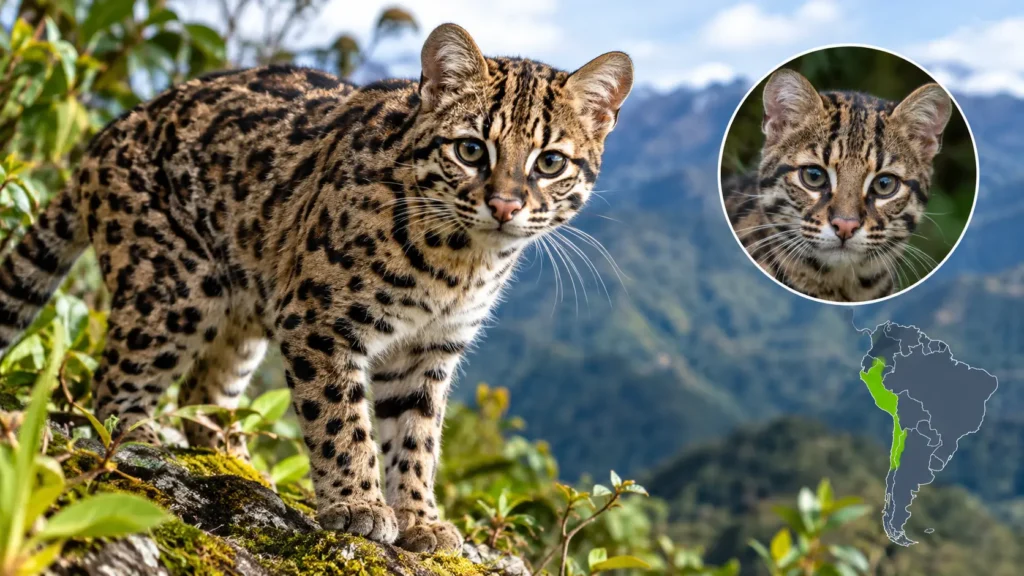
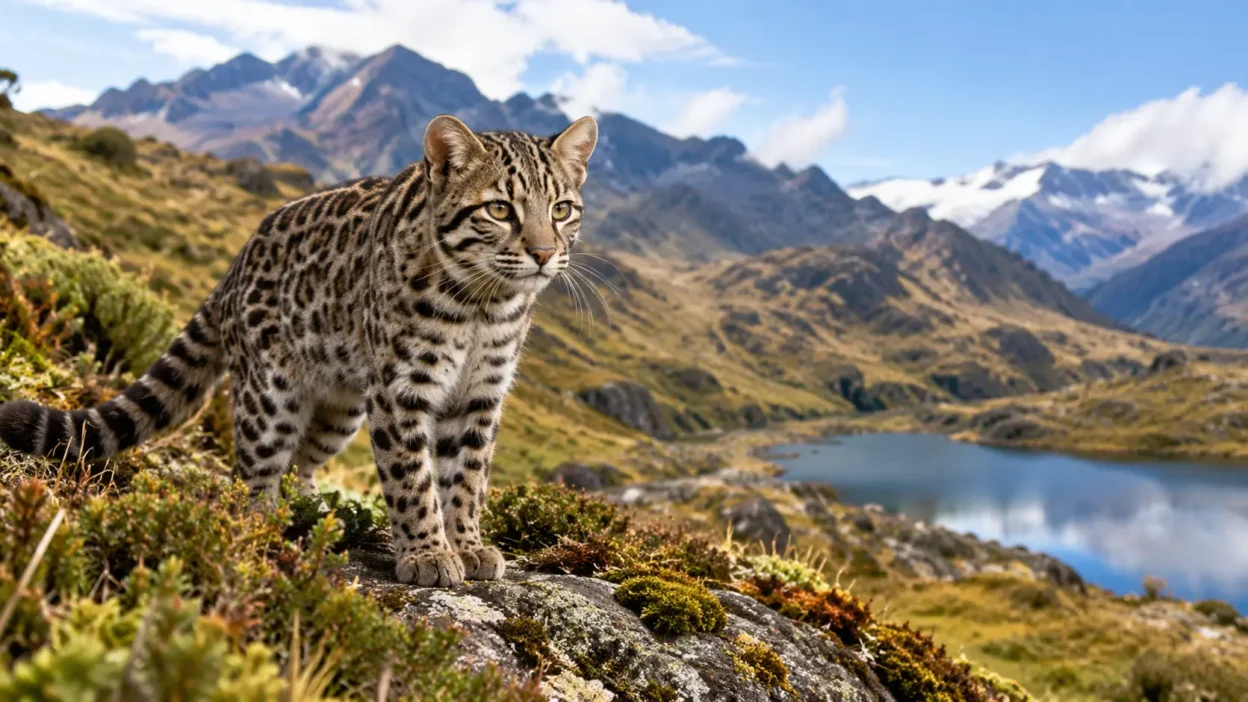
If you love animals, you’ve probably heard the exciting news: scientists found a brand-new wild cat species. It’s called Leopardus tilcayo, and it’s a huge deal because no new living cat species had been named in over 100 years. So, naturally, people want to know one big thing – where does this tiny, spotted cat actually live? Let’s break it down in simple terms.
What Is Leopardus Tilcayo?
Before we talk about its home, let’s meet the cat. Leopardus tilcayo is a pint-size tiger cat discovered in Bolivia in the Yungas forests of the central Andes Mountains. It’s part of a group called “tiger cats,” which are small, spotted wild cats related to the more famous ocelot.
This little cat is tiny. It measures about 46cm (18 inches) long and weighs around 1.4kg (3 pounds), making it smaller than an average house cat. It has muted fur, extra-large spot markings, and a smaller frame than a typical housecat.
Leopardus Tilcayo Habitat: Where Exactly Does It Live?
Short answer: They live in a specific area of cloud forest in Bolivia.
Leopardus tilcayo live in the Yungas cloud forest region of Bolivia. A cloud forest isn’t your usual idea of a forest. It is much cooler and moister, often found on steep hillsides high up in the mountains.
The Tilcayo tiger cat only inhabits the Yungas region of Bolivia; this is a unique area known as an ‘ecotone’ and consists of a mixture of the Andes mountains and the tropical rainforest of the Amazon. Therefore they are found living in the transitional phase between the dry, tall mountains and the wet green lowlands of the Amazon. This means they have a very specific habitat with a specific climate and vegetation which very few animals can adapt to.
Native Region of the Tilcayo Cat
When people ask about the “native region” of this cat, they’re really asking: where did it originally come from, and where is it found naturally in the wild today?
The tilcayo was discovered in the Yungas forests of the central Andes Mountains in Bolivia. This region sits in a narrow strip along the eastern side of the Andes, where humid air rolling in from the Amazon gets trapped by the mountains, creating thick clouds and constant moisture. It’s a rich, green, biodiverse strip of land – but also a fragile one.
Genetically, this cat has deep roots in the area too. Genetic analysis suggested that the tilcayo lineage separated from other tiger cats about 1.4 million years ago. That means this cat has likely been quietly living in these same mountain forests for over a million years, just without a scientific name – until now.
How Was the Tilcayo Discovered?
This feline wasn’t discovered by scientists though.
In the lush Yungas cloud forest of Bolivia, the species has been well-known to local communities for many years. It is known as a tilcayo. Rather than creating a new made up name in Latin, the scientists chose to honour the local name. The team decided to make it an official name.
After researching 38 cats (26 leopardus) in the most detailed genetic study of these cats ever, it has been officially confirmed. On the 17th September a paper was published in Current Biology confirming this as the first new living species of cat to be identified and named in over 100 years. The last new species was the Uruguayan pampas cat identified in 1923.
As of right now the only known individual in captivity is at a sanctuary in Bolivia. They have been receiving long term care since 2017. So far the species has only been confirmed using two known individuals; one photographed in the wild and Tigrino who is living in captivity.
Why Its Habitat Matters So Much
This is an important section and can be quite worrying.
Currently, the cloud forests that the Tilcayo lives in are disappearing at a rapid rate due to agriculture and human development. Additionally, genomic information shows that there has been a huge decrease in the Tilcayo tiger cat’s population; decreasing by 63% since the change from the Pleistocene to Holocene epoch.
Because the tilcayo is a new species, it is currently listed as ‘Not Evaluated’ meaning it needs its own conservation status to be legally protected. We don’t really know much about it yet. Scientists hope to learn more about what they eat, where they live and how many are in the wild shortly. One scientist stated ‘We have no idea how many there are in the wild.’
Therefore scientists have set up camera traps in the forest. Lead scientist Paola Nogales Ascarrunz has been putting camera traps in the Yungas forest to help record more wild tilcayo cats.
Quick Facts: Leopardus Tilcayo at a Glance
| Common name | Tilcayo tiger cat |
| Scientific name | Leopardus tilcayo |
| Habitat | Yungas cloud forest, Bolivia |
| Region | Central Andes Mountains, Bolivia |
| Weight | About 1.4-2 kg (3 lbs) |
| Length | Around 46 cm (18 inches) |
| Conservation status | Not Evaluated (urgent assessment needed) |
| Discovery announced | September 2026 |
FAQ: Leopardus Tilcayo Habitat
Q1: Where is the Leopardus tilcayo found?
It’s found in the Yungas cloud forest of Bolivia, in the central Andes Mountains, where the mountains meet the edge of the Amazon basin.
Q2: Is the tilcayo cat found anywhere outside Bolivia?
So far, no. It’s currently known only from Bolivia’s Yungas region. A related subspecies, the Antisuyo tiger cat, was identified in nearby Peru, but it’s a separate population.
Q3: What kind of habitat does the tilcayo prefer?
It lives in humid, misty mountain cloud forest – a cooler, damp environment very different from dry lowland forests.
Q4: Why wasn’t the tilcayo discovered sooner?
Local communities already knew the cat existed and called it “tilcayo.” It simply hadn’t been formally studied and confirmed through genetic science until recently.
Q5: Is the Leopardus tilcayo endangered?
It hasn’t been formally evaluated yet, but its habitat is shrinking fast due to farming and development, and researchers are pushing for quick conservation action.
Helpful Resources
Scientific American: See the first new species of cat discovered in more than a century
ScienceNews: Meet the newest living cat species
National Geographic: Photos show new species of wild cat discovered in Bolivia